Not long ago, "is this track made by AI?" was not a question anyone at a label had to ask. Now tools like Suno and Udio can make a finished-sounding track, vocals included, in minutes. Some of those tracks end up in demo inboxes. Some end up in promo campaigns.
Most labels have an opinion about it. Very few have written it down. That is worth changing, and it takes less time than you might think.
Why write it down
- It is fair to artists. If artists know your rules before they send, nobody wastes their time, and nobody feels accused later.
- Your team decides the same way. When two or three people listen to demos, a written policy means the same track gets the same answer, whoever hears it first.
- It protects your releases. Who owns the rights in AI-generated music is still unsettled, and distributors and stores are setting their own rules for AI content. You want to know what you are releasing before it goes out.
What an AI policy can cover
- What you accept. No AI at all? AI tools for mixing or mastering, but not for writing? No generated vocals? Choose your line and say it plainly.
- What you ask artists to tell you. For example, any AI tool used to make the track, and which parts it made.
- What you check. Your ears, the file tags, an AI check, and stems when you are unsure.
- What goes in the contract. A promise from the artist about how the track was made, so the deal rests on it.
- What happens when you are unsure. Usually: ask, politely, before anything else.
Put a short version where artists will see it, such as the text at the top of your demo form.
Check, don't accuse
No detector is perfect. A result is an estimate: a strong reason to ask questions, not proof. New generators, processed audio and tracks that are only partly generated can all fool a detector, in either direction. So when a track is flagged, listen again and ask the artist for stems or a screenshot of the session. Most real producers are happy to show their work.
Our guide How to tell if a song is AI-generated goes through the signs you can hear and the details worth checking.
The AI check across Ctrl Promo
We have built the AI check into every place where music arrives in Ctrl Promo.
- Every demo. Every track sent to your Demo Box is checked for the traces that generators such as Suno and Udio leave in the audio, and for generator names in the file tags. Filter your inbox to see only the flagged demos, and see them in your weekly summary.
- Demos from anywhere. Got a demo by email or WeTransfer? Upload it on the AI Check page, several tracks at once, and the results appear by themselves.
- Every promo track. The tracks you upload for a promo campaign are checked too. The results are only for you: they are never shown on your campaigns or to the DJs who receive them.
- In your contract. Our example release agreement includes the artist's promises about AI, ready to use or to change.
Free for everyone
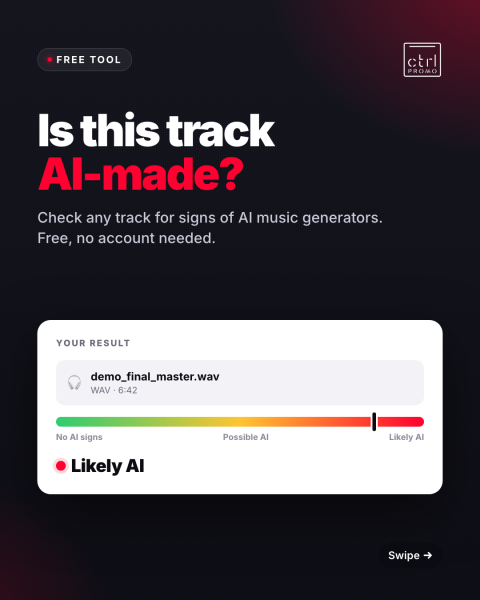
Not using Ctrl Promo? Our free AI music checker is open to anyone: artists, DJs, labels and curators. Upload up to 3 tracks a day (MP3, WAV, AIF, FLAC, M4A or OGG, up to 15 minutes each) and get the result by email in about a minute. The audio is deleted after the check.
Artists can use it too, before sending a demo. If your track is your own work, a clean result is one less question for the label.